

Here’s a pattern I’ve come to believe, after spending most of my adult life building businesses and thinking about how to stop trading hours for money: the less capital you have, the more you pay in time and risk instead. Money and effort are substitutes on a sliding scale. You don’t escape the cost of freedom - you just choose which currency you pay it in.
Let me make that concrete. Say the goal is to generate enough passive income to cover a comfortable life without working - pick a number, say $7,000 a month. There are very different ways to get there, and each one trades money against time and risk in a different ratio.
1. Passive investing - most money, least work. Park enough in a diversified portfolio and live off a safe withdrawal rate (the rule of thumb is around 4% a year). For $7,000 a month, that’s somewhere around $2 million invested. Maximum capital, near-zero time, lowest risk. The cleanest path - if you happen to have $2 million.
2. Real estate - less money, more hassle. Income property gets you there with less capital, because the asset works harder (and so do you). A rental might return 6–8% net instead of the market’s long-run average, but now you’re buying, managing, maintaining, and carrying real risk - vacancies, downturns, the tenant who floods the bathroom. Less money in; more of your time and attention out.
3. Buying a small business - less money still, more involvement. You can acquire an existing, profitable small business instead of building one from scratch. Software businesses, for instance, typically sell for somewhere around 3–4× their annual profit. So a SaaS business throwing off $100,000 a year in profit would cost you roughly $300,000–400,000 to buy - and that $100k/year is most of the way to our $7,000-a-month goal. Far less upfront than the ~$2M you'd need for pure passive investing. The catch: you're not buying a hands-off asset, you're buying yourself a job - you now have to run the thing (or pay someone who can), and carry the risk that its revenue erodes, a competitor shows up, or the platform it depends on changes the rules.
4. Building a business - least money, most time and risk. The far end of the scale. Instead of buying that $100k/year business for $300–400k, you build your own version from scratch - for the cost of a domain, some software tools, and months (often years) of your own labor. I've started software businesses for under a couple of thousand dollars that went on to make multiples of that. But for every one that works, several die quietly - the financial cost of each attempt is tiny, but most attempts simply don't reach paying customers. That's the trade: the money barrier is almost zero, so you pay almost entirely in time, effort, and the very real chance that the thing you build never earns a cent.
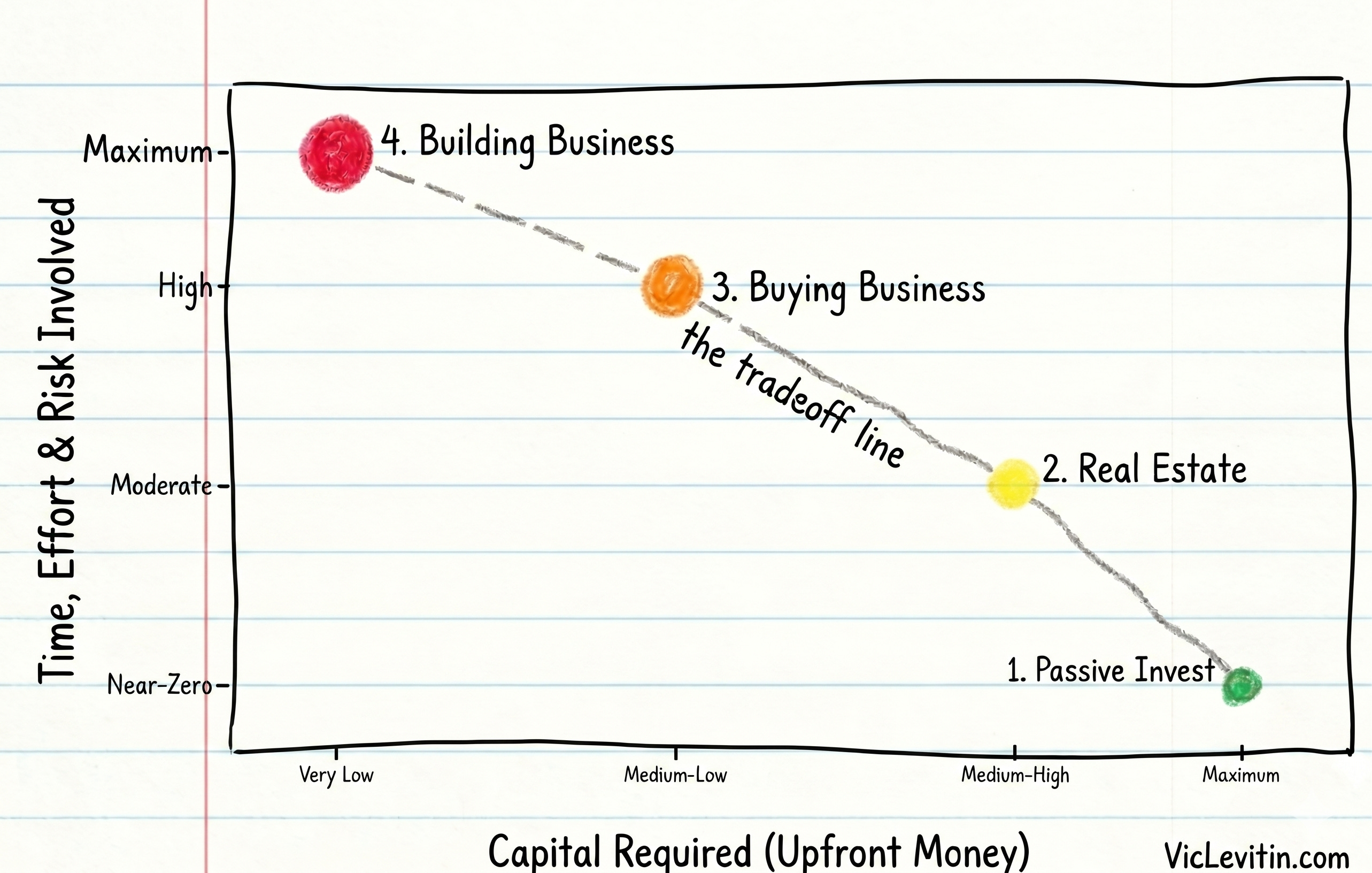
Look at the line that forms: ~$2 million → ~$400k → ~$300k → the cost of a domain name. Same destination - about $7,000 a month in income that doesn’t depend on your hours - at wildly different price tags. And every step down in money is a step up in time and risk. That’s the whole thing. There is no path that’s cheap in money and cheap in effort and low in risk - if there were, everyone would already be on it. Freedom has a price; you only get to choose the currency.
Which is oddly clarifying. If you have the money, buy your freedom with money - park $2 million and never think about it again. If you don’t, and most people don’t, then you buy it with time, effort, and a willingness to bet on things that might not work - you build the $100k business instead of buying it. Knowing that stops you from waiting for an option that doesn’t exist, and gets you choosing which currency you’re actually willing to spend.
For me, the honest answer is a mix - some money invested passively as a floor, and time spent building on top of it, balancing what I can put in financially against what I’m willing to put in with my hands. And one quiet rule underneath all of it: if the entire point is buying back my time, I’d rather not spend the years getting there doing something I hate.