

The biggest heist in human history wasn’t pulled off with guns or brute force; it was done with glass.
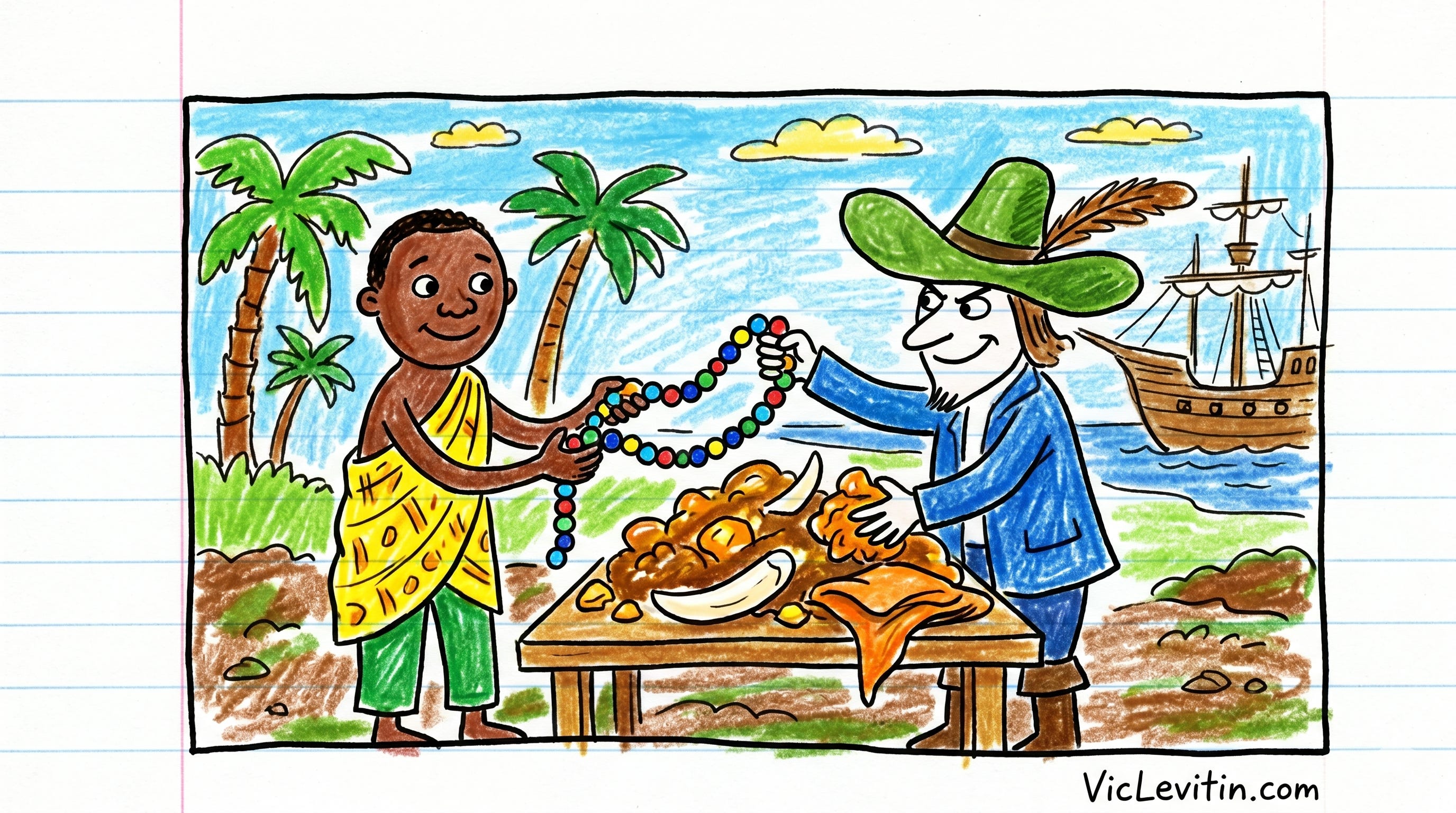
Back in the 16th century, the currency of choice in West Africa was glass beads. The locals didn’t have the technology to manufacture glass, making these beads a scarce resource that required serious effort to acquire. They arrived via complex overland trade routes, and people traded high-value goods like gold, ivory, and spices- things that took real backbreaking labor to produce - just to get them.
And then, the Europeans showed up.
As soon as European traders hit the African coast, they realized exactly how much those glass beads meant to the locals. So, they did what any enterprising colonizer would do: they flooded the continent with cheap, mass-produced beads made in Venice. Using this practically free “money,” the Europeans bought up goods, gold, and eventually, human beings as slaves.
The result? A whole continent’s wealth, time, and energy were sucked into a product with zero intrinsic economic value. These “Slave Beads” went down in history as the ultimate textbook example of a system where one side manufactures currency with minimum effort, while the other side works themselves to the bone for it - a heist executed without firing a single shot.
Money is Just a Story We All Agree to Believe In
We recently sold our house. The return I got for it is just a bunch of larger digits in my digital bank account. This whole transaction worked for one reason only: I believe that some total strangers in the future will be willing to give me real-world, valuable goods and services just so I can tweak those same digital numbers in their accounts - numbers that have absolutely no real-world value on their own.
If I were to travel 10,000 years back in time with my impressive new bank balance, or even a suitcase stuffed with millions of dollars in cash, I probably wouldn’t be able to buy anything of substance. Unless, of course, someone back then thought my green illustrated papers had nice decorative value.
That’s because 10,000 years ago, at the dawn of the Agricultural Revolution, the story of money hadn’t been invented yet. People exchanged actual value and physical goods - chickens for sacks of wheat, and so on.
This exact storyline repeats itself throughout history.
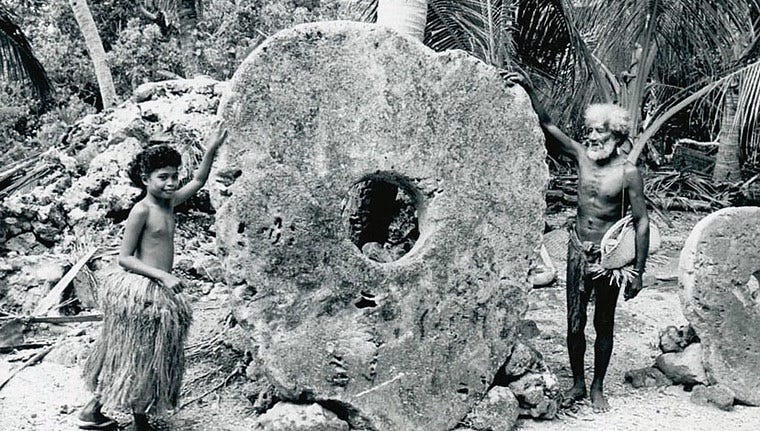
Take the Yap Islands in the Pacific Ocean, where giant “Rai stones” functioned as currency. Their value came from the sheer difficulty of carving them out of limestone on the distant island of Palau, and then rowing them 400 kilometers back home across the treacherous open ocean in canoes. The more labor and risk a stone required, the more it was worth. That’s Proof of Work right there - the very difficulty of producing the currency is what protects it from being counterfeited. (By the way, that’s what gives Bitcoin its value too.)
This worked beautifully until the 19th century, when an Irish captain named David O’Keefe showed up with a modern ship. He started hauling massive stones from Palau cheaply and in bulk, effectively “hacking” the currency and making himself the richest man on the island.
In short: When one side can produce the currency for free, commerce turns into polite robbery.
So, What’s Our Situation Today?
Honestly? Not much has changed.
If the Europeans back then actually had to manufacture glass in Venice, and David O’Keefe had to physically haul heavy stones on a ship - today, governments and corporations can manufacture money with zero effort, from an air-conditioned office, with a simple tap on a keyboard.
A global pandemic hits? Need more cash? Click, click - and boom, another $10 trillion is injected into the market.
Meanwhile, the rest of humanity has to trade their life energy, skills, and that most precious, finite resource of all - time - just to earn that same money.
Wait, so the government is basically acting like those Europeans flooding Africa with worthless glass?
Yeah, pretty much - except not out of malice. Governments print money to keep economies from collapsing, to fund crises, to avoid mass unemployment. The intent is usually to help. But the effect on whoever’s holding the cash is the same: their savings quietly lose value, whether the motive was greed or rescue.
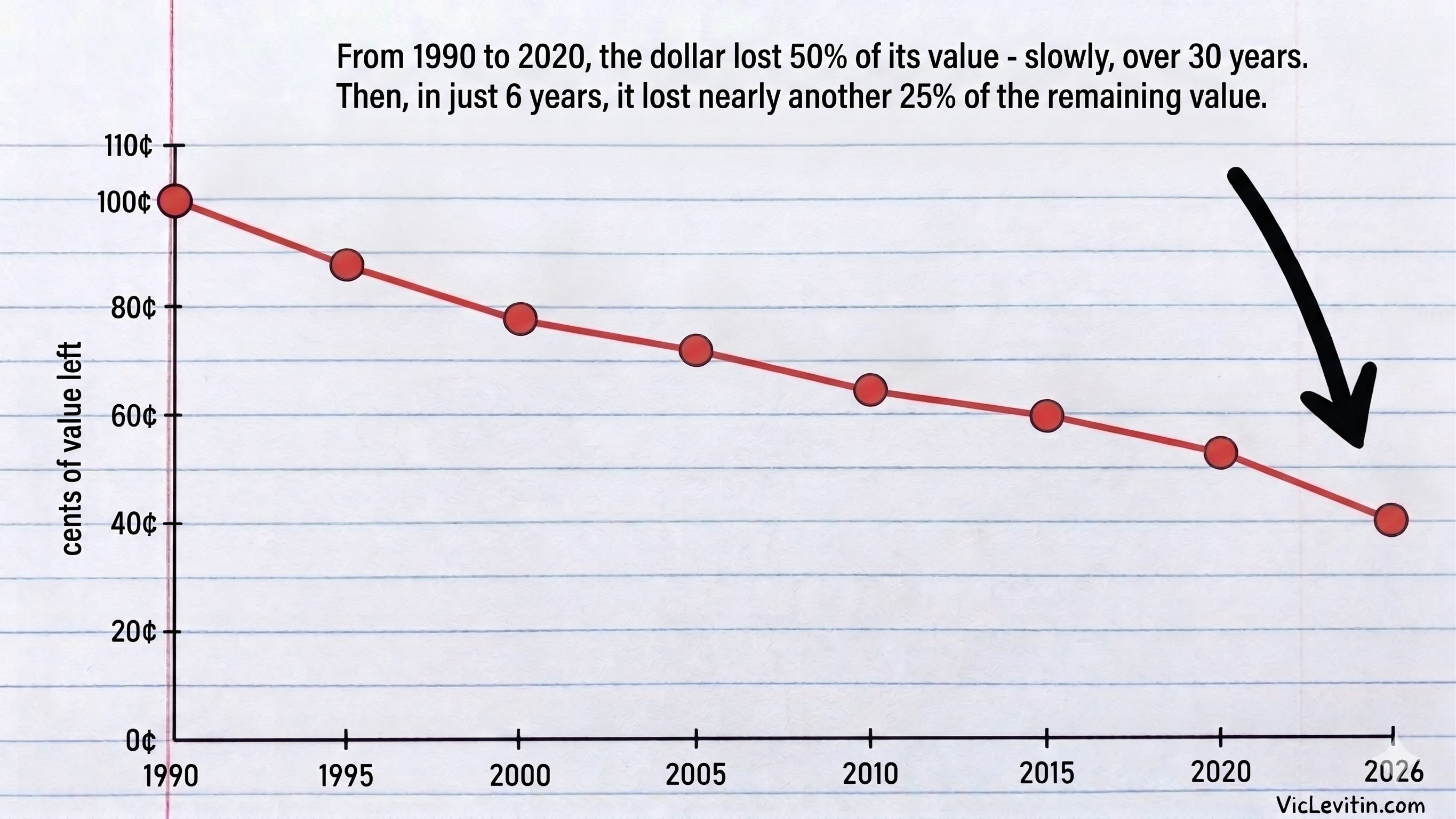
Take your average grocery cart as an example. If it cost $100 in 1990, by 2020, that exact same cart cost nearly $200. In other words, your dollar lost half its purchasing power - slowly, quietly, over thirty years. That was the “normal” rate of decay.
And then COVID-19 happened, and the game changed. To keep the economy afloat, trillions of new dollars were birthed in a tiny window of time. The money supply (every single dollar existing in bank accounts and cash) spiked by about 40% in just two years. When you almost double the amount of money floating around but don’t double the amount of stuff there is to buy, each dollar naturally buys less.
And that’s exactly what went down. The kind of wealth erosion that used to take a decade happened in just two to three years. Inflation hit a 40-year high, and purchasing power evaporated by more than 20% in a flash. That grocery cart got expensive again - only this time, it happened at warp speed.
The Africans in the 16th century weren’t stupid - they just had no way of knowing the Europeans could manufacture their currency for free. We, on the other hand, do know.
So, what am I doing with my glass beads?
My logic is dead simple: in every historical script, the people who got wiped out were the ones holding the stuff that was easy to replicate - glass beads, stones, digital numbers. The winners were the ones holding the stuff you can’t fake: gold, land, real assets. So, I try to stay on the side of the fence that can’t be manufactured out of thin air.
So here's what I actually hold:
Broad Market Index Funds (ETFs): When new money gets pumped into the economy, it doesn’t just vanish; it flows somewhere. A huge chunk of it flows straight into the biggest, most profitable companies in the world through the stuff we all buy and use every single day. Instead of holding onto cash that’s actively melting away, I prefer owning a piece of the companies that the cash is flowing into - assets that generate real value, rather than paper explicitly designed to lose it.
Tax Optimization: As a tax resident of Thailand, I’m not subject to the Israeli 25% capital gains tax - which is a pretty sweet leverage point.
Bitcoin: If stocks are a stake in the engines of production, Bitcoin is the direct antidote to the glass bead problem. It’s the only asset out there with a genuinely fixed supply - 21 million, final, hardcoded. No government, bank, or tech breakthrough can print more of it. Unlike gold (which we keep mining) and thde dollar (which we keep printing), Bitcoin cannot be diluted. For the first time in human history, the “beads” are finite.
I have no idea what the future holds, and I’m certainly no financial advisor - but I don’t want to be the one holding the glass beads.