

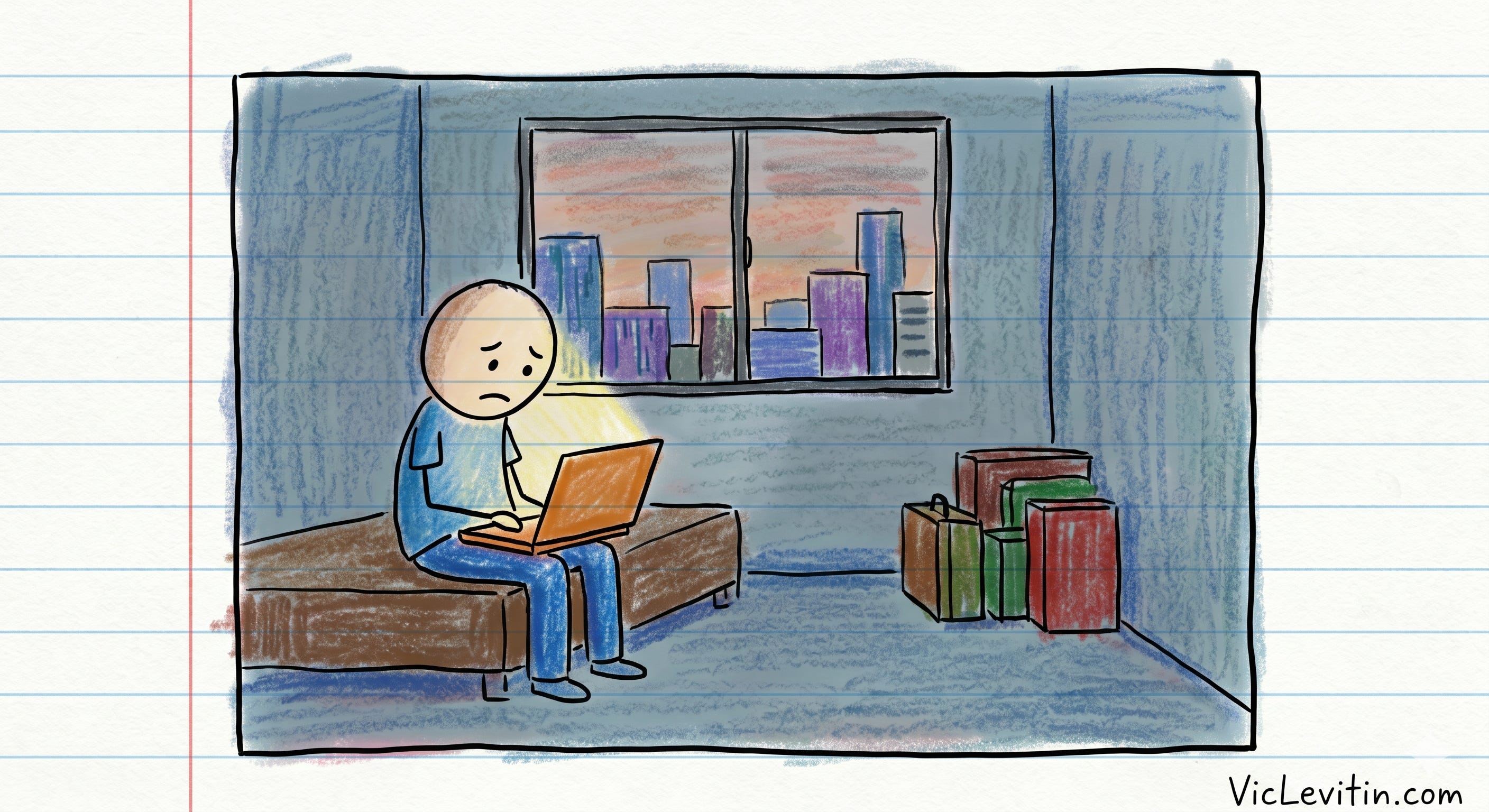
A hotel room in Hanoi. 14:29, Monday. I’m at my laptop, refreshing my inbox every ten seconds.
We’re waiting on Lital’s visa (my wife) from the Thai embassy, so we can go home - to Thailand. I got mine a week earlier, in an email that landed at 14:27. Friends we were traveling with got theirs a few days later, at 14:29. We figured out there’s probably an automated system that sends the approvals in a window of a few minutes before three. So every day, just before three, I sit and refresh.
Two and a half weeks have passed. The friends already went back to Thailand. We’re still here - stuck for another weekend because the embassy is closed, waiting for it to reopen Monday. The kids have missed two and a half weeks of school, glued to their tablets. The Vietnamese never did anything to me, but I can’t stand the sight of Vietnam anymore. I just want to go home.
14:30. I keep refreshing, but the hope is draining out. At 14:35 I accept reality - we’re stuck here another day. I let out a breath and book another night at the hotel.
I called the embassy. I went there in person. All I get is “nothing to do, just keep waiting.” A blank wall.
My whole life I’ve made choices to give myself as much freedom as possible. And now, for two and a half weeks, my whole family’s life is on PAUSE. We’re living out of suitcases in a hotel, completely dependent on some random clerk I’ve never met, who’ll sign Lital’s paper whenever it suits him. There’s no arguing with him, no one to call, nothing to do but wait.
How did we get here? Why did we even have to leave our home in Thailand to get permission to come back to it?
Turns out it all started with a Serbian guy with a gun.
When the World Was Open
A little over a hundred years ago, in most of the world, you didn’t need a passport to cross a border. Passports existed - but they were an option, not a requirement. One could buy a ticket in Europe and board a ship to America, or sail from Germany to China, and step off on the other side without a single official asking who he was or why he’d come. No visa issued in advance, no fingerprint, no embassy interview. The closest thing to a passport actually served the opposite purpose to today’s: not a document the state demands to prove you’re allowed in, but a kind of letter of protection a nobleman or merchant would request from his ruler - a note asking the authorities along the way to treat him well and help him out if he ran into trouble. For the ordinary person, it didn’t apply. You just showed up.
And in my own neighborhood specifically - in the late 19th century, Siam (today’s Thailand) threw its gates wide open. King Rama V wanted working hands to build ports, railways, canals. So he just opened the door and invited everyone in.
Between 1825 and 1910, the Chinese population in Siam grew from 230,000 to nearly 800,000. Thailand almost never closed the door. People just arrived, unpacked their bags, and lived - no passport, no visa, no flying to a neighboring country to sit in a hotel and refresh email like an addict.
Then came 1914. Someone shot an Austrian duke, and half the planet decided that was an excellent reason to kill each other for four years.
And in the chaos, in a short span of time, government after government reached the same conclusion: if we’re in a world war, we’d better know exactly who’s crossing our borders. Maybe this guy’s a spy. Maybe he’s dodging the draft. Let’s make everyone carry a document with a name and a photo.
That’s how the modern passport was born. Not as an orderly plan to run the world, but as a temporary emergency measure in the middle of a war. Britain and France started, and within a few years the whole world had shut itself behind fences.
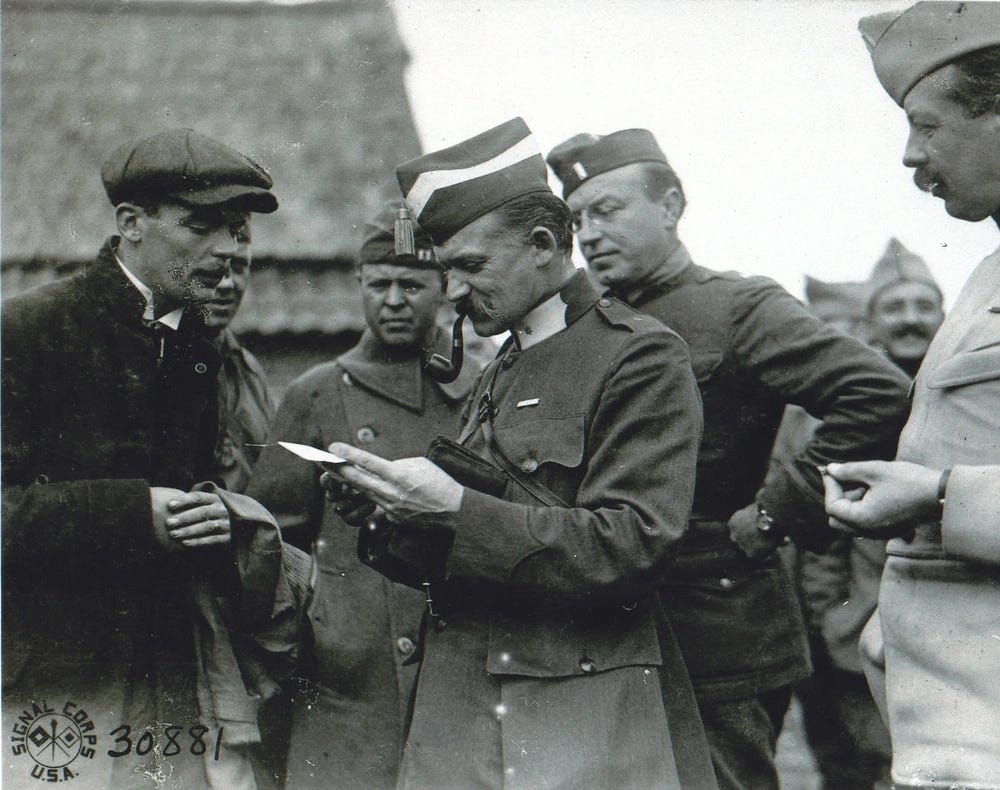
Thailand joined in 1917 - not out of a desire to control its own residents, but out of necessity. When the whole world suddenly demands passports, your own citizens and merchants get stuck in foreign ports without papers. So Thailand had to build a fence of its own, just so its people could get the key that would move them through everyone else’s fences.
Friend or Enemy?
Passports and visas were supposed to be a temporary fix. After the war, in the 1920s, more than a few leaders and international officials hoped they’d go back to being an emergency measure only, and that we’d return to the freedom of movement of before 1914. It didn’t happen - partly because governments don’t tend to give up tools of tracking and control. A fence is a lot easier to build than to take down. A hundred years later, I’m paying the cost of that fence still standing, in a hotel room in Hanoi.
And this history explains exactly why I, of all people, got stuck.
The passport was born from a wartime mentality, to answer one question: is this person ours or not ours? Friend or enemy? It’s completely binary thinking. And it worked fine as long as people really were one of two things: either citizens who live inside, or tourists who come for a short visit and go back to their “home country.”
Except my family and I are neither.
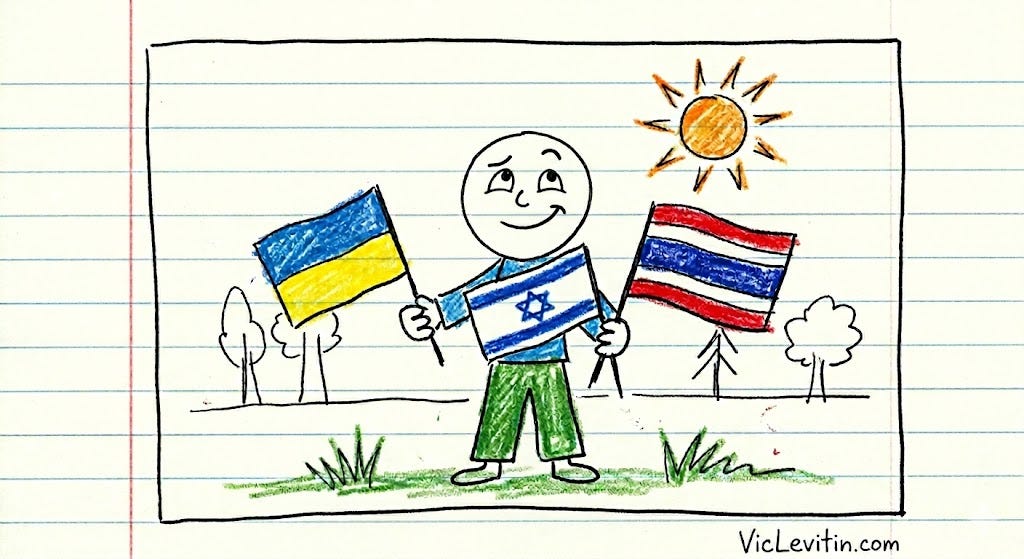
I’m not a Thai citizen - and I’m not a tourist either. I was born in Ukraine, raised in Israel, and I’m raising my kids on an island in Thailand. I live there, the kids go to school there, we adopted a dog, we fucking learned Thai - but I don’t have a Thai passport. I have an Israeli passport, and Israel is the place every system assumes I “return” to. Except I’m not returning there right now. I live in Thailand. That gap - between the country my paper points to and the place I actually live - is exactly the hole I fall into.
And the problem isn’t that there’s no slot for me. There are visas today for nomads, for temporary residents, for foreign workers - you can find a form. The problem is that all of those slots are built on the same assumption: that you’re here temporarily, and that your real home is somewhere else. Every one of those visas basically says, “we’re hosting you for a while - and then you’ll go back to where you belong.”
Except I don’t belong somewhere else. Thailand is home. This is where I live, where the kids are growing up, where the life is being built. I’m not trying to sneak in, not looking for a loophole - I just want the paper to recognize what already exists: that I live here. A long-term visa, a stable status, without counting days until the next renewal.
But here’s the absurd part: to move into that status - the status of someone who lives here - I first had to leave here. You can’t switch visa types from inside. You have to leave the country, apply from a Thai embassy abroad, and wait there for permission to come back in.
To get the status of “someone who lives in Thailand,” I had to stop, for a moment, living in Thailand.
Once I get this visa, I’ll be stable. I won’t have to leave again. But the transition itself - the moment I officially turn from visitor to resident - the system insists I do from the outside. Because in its eyes, “entering” is something that only happens from the outside, even when you’re already inside. Even when you’re already home. So I packed up the family, left my home, flew to a foreign country, paid for hotels, and refreshed an inbox until my finger hurt.
Early Adopters of a New Way of Living
I’m describing the problems of the privileged here. There are people who cross borders to flee terrible things. My parents fled antisemitism in the Soviet Union in 1990, with no property, no means, with a box of vodka bottles they traded for bananas in Hungary on the way to Israel.
Our choices today come from wanting to build a life that fits us better, not because we’re fleeing something terrible.
So think about who early adopters really are. They’re not smarter or braver than anyone else. They’re just people whose need for something is so strong that they’re willing to suffer for it. They buy the first version of the product - the one that crashes halfway, that’s missing half its features, that has no support - because what it gives them is worth more to them than all the bugs. They pay in frustration now, in exchange for something everyone else will get polished and convenient only years later.
That’s me, with this way of living. My need to live where I choose - without anyone deciding for me where I “belong” - is apparently strong enough that I’m willing to absorb the system’s bugs. And the bugs are big: flying to a foreign country to ask permission to come home, two and a half weeks in a hotel, forms in Thai designed for a tourist from the 1950s. This is the first, janky version of living without one country managing you. It doesn’t have tech support yet.
One day maybe they’ll build a system that fits people like me. Meanwhile, I’m sitting in a hotel room in Hanoi, refreshing email.
And I’d still choose this again.